
The 5 Crypto Risk Management Rules That Actually Work
The disciplines traditional investors live by, and what they actually look like in digital assets.


NOTE: A quick note before we dive in. Today's piece is a collaboration between Mari Savic and myself, written together and published here on BitFinance. We've been thinking about the same problem from different angles for a while, and risk management was the natural place to combine notes.
If you're new here from one of our publications, welcome. The piece below is one cohesive argument we both stand behind, not two essays stitched together.
******
Most crypto traders learn risk management the hard way. They take a big position, the market moves against them, they freeze, and by the time the loss becomes real, they’ve already learned a lesson that cost more than it had to.
Between the two of us, we’ve watched this play out for more than fifteen years. The traders who survive multiple cycles share something most of the rest don’t. They built their risk discipline before they needed it.
The five rules below come from how traditional portfolio managers, hedge fund risk officers, and family office allocators actually run money. They aren’t complicated. They aren’t new. They work because they all derive from a single insight.
Capital you preserve compounds.
Capital you lose has to be re-earned at exponentially worse odds.
That second part is the one most retail investors never internalize. The math is harder than it looks, and it’s the reason every rule below exists.
RULE 1: Don’t Risk More Than 1-2% on a Single Trade
The Warren Buffett Mantra: "Risk comes from not knowing what you are doing."
Professional portfolio managers almost never let one trade put more than 1-2% of their total capital at risk. In crypto, it’s common to see people put 20% or 30% into one altcoin because the conviction feels strong. Conviction is not a position-sizing model.
Crypto moves fast and drops hard. A normal 50% drawdown on a large position can erase months of gains in a single week. The 1-2% rule isn’t about being scared. It’s about staying alive long enough for your winners to actually work.
The math is simple. Your max loss on any trade should be a fraction of your account, not a fraction of the position. Once you decide the max loss, the position size becomes a calculation rather than a feeling.
Position Size = (Account × Risk %) ÷ Stop Distance %
Run the numbers for an account willing to risk 1% per trade with a 20% stop:
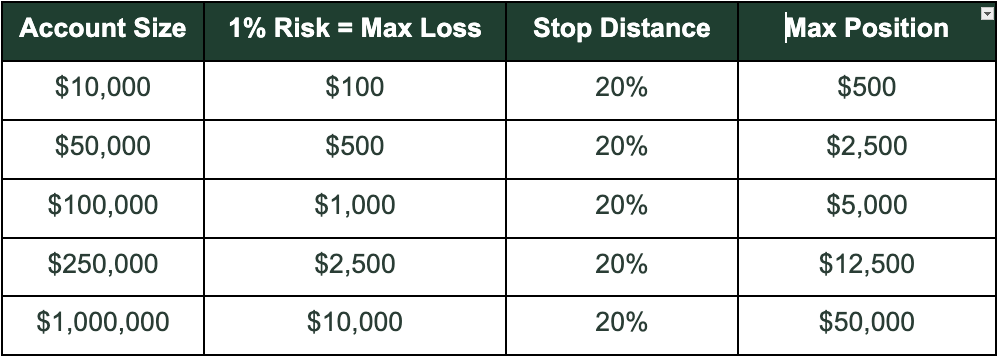
Most retail crypto traders size by gut feel and then wonder why a single bad trade wipes out three months of gains.
The fix is to size first, then enter. Ultimately the goal is to make sure you can stay in the game because no single trade wrecks the entire portfolio.
RULE 2 : Set Your Stop Before You Enter, Not After
The Warren Buffett Mantra: “The most important thing to do if you find yourself in a hole is to stop digging.
Traditional investors rarely enter a trade without a clear plan for both downside protection and profit taking. In crypto, many people hold with diamond hands until they’re down 80-90%, then panic-sell at the bottom. That looks like conviction from the outside, but it functions like denial.
A real plan has three parts. Where you exit if you’re wrong. Where you take partial profits if you’re right. What signal would change your mind before either trigger fires.
Set the stop based on a technical level, a volatility band, or the moment the original reason for the trade no longer applies. Stops aren’t predictions about where the market will go. They’re admissions that you can’t predict, and you’d like to be wrong cheaply.
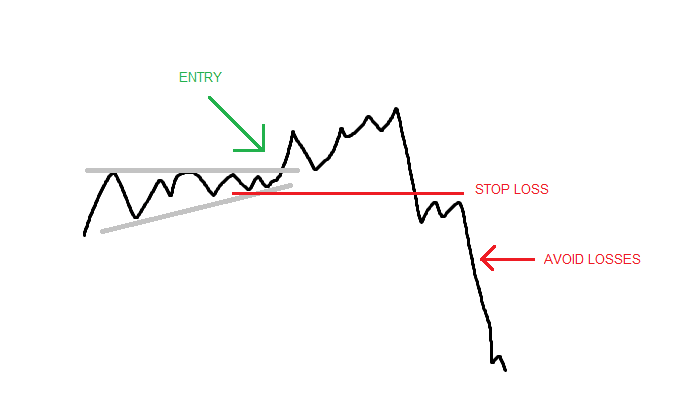
The other piece worth setting before the trade is the risk-reward ratio. If you’re risking 20% to make 20%, you need to be right more than half the time just to break even after fees. If you’re risking 20% to make 60%, you can be wrong twice as often as you’re right and still come out ahead. Look for setups where the math favors you before the trade even starts.
RULE 3: Cap Your Whole Portfolio, Not Just Each Trade
Warren Buffett Mantra: "The riskiness of an investment is not measured by beta but rather by the probability of that investment causing its owner a loss of purchasing power over his contemplated holding period."
Serious investors control risk at the portfolio level, not just the individual trade level. That means hard rules like a maximum 10-20% drawdown before reducing exposure across the board. Limits on how much capital can sit in any one sector or narrative. Caps on correlated assets.
Crypto traders often pile into whatever narrative is hot, then wonder why everything moves together when sentiment turns. Holding eight Layer-1 tokens isn’t diversification. It’s one bet wearing eight different costumes.
Correlation is the silent killer in crypto. During a normal market, an altcoin bag might look diversified. During a real selloff, everything trades like one position. The portfolio-level cap is what protects you when correlation goes to 1.0, which it always does at the worst possible moment.
A 25% allocation to crypto across four uncorrelated assets behaves very differently than a 25% allocation to four assets that all crash together. The number on the position sheet is not the number on the risk sheet.
RULE 4: Shrink Position Size When Volatility Rises
Warren Buffett Mantra: "Be fearful when others are greedy, and greedy when others are fearful."
When markets get crazy, professional traders make their positions smaller. In crypto, when things get volatile, most retail traders do the opposite. They add leverage because they think the moves will be faster.
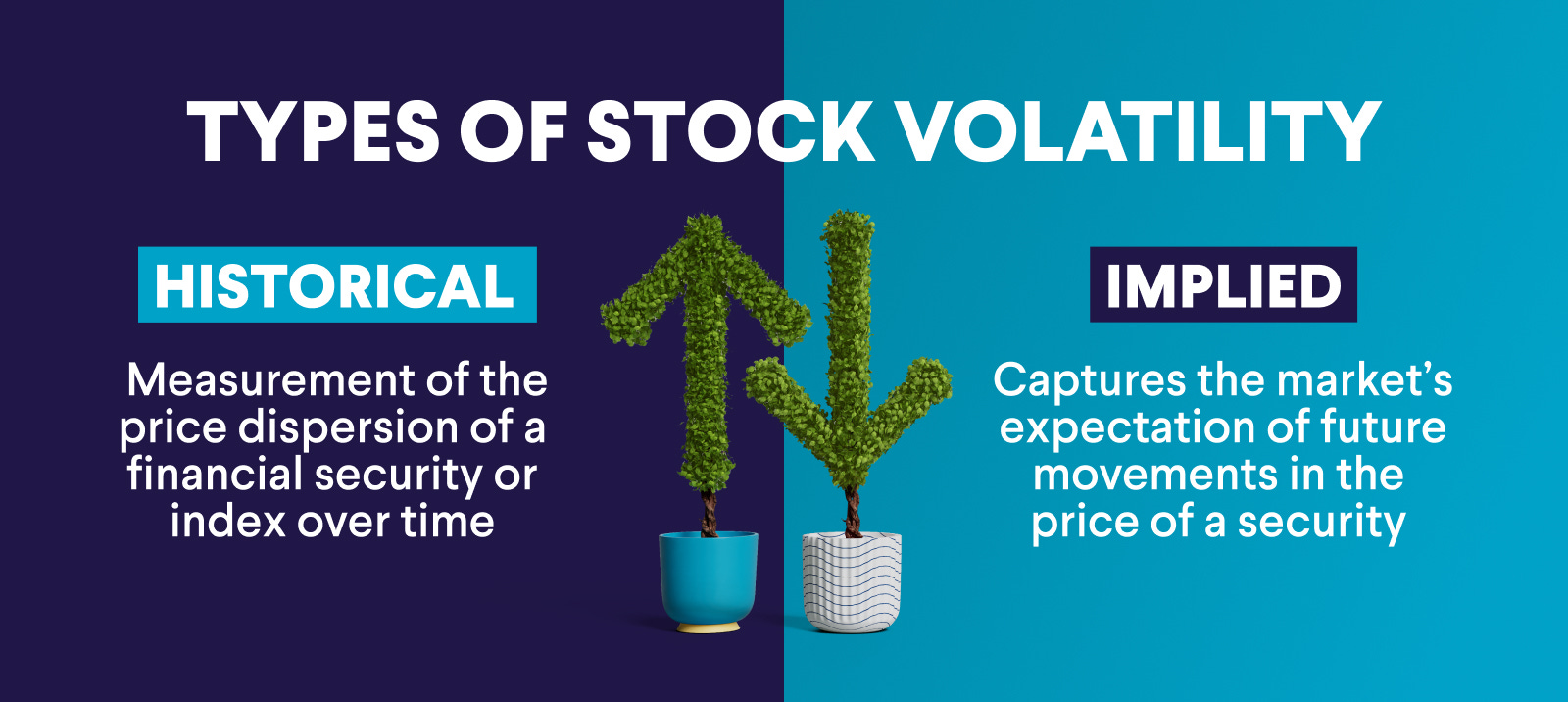
Faster moves with leverage means faster liquidations. The reason professionals shrink positions during high-volatility periods is the same reason airlines lower their flight altitude in turbulence. The cost of being wrong gets higher when conditions get rougher.
A simple way to scale positions to volatility is to look at average true range, or ATR. When ATR doubles, your position size should roughly halve to keep the dollar risk constant. This sounds like extra math, but in practice it’s a single calculation per trade. It’s also the difference between surviving a volatile week and getting carried out.
The trader who sizes the same in calm markets as in panicked ones is taking double the risk during the panic. The dollar amount on the position sheet looks identical. The actual exposure is not.
RULE 5: Preserve Capital First. Always.
Warren Buffett Mantra:
Rule #1: Don’t lose money.
Rule #2: Don’t forget the first rule.
Most crypto traders focus on maximum upside. Experienced investors focus first on not going to zero.
The question to ask before every position is whether you can sleep with it. If the answer is no, the position is too big. Cut it until you can sleep.
The traders who make it through three or four full cycles all share this discipline. They keep meaningful cash or stablecoin reserves, often 20-50%, so they’re ready when the next opportunity arrives and protected when the next selloff does.
The reason capital preservation matters more than upside capture is the recovery math. This is the chart most retail investors have never been shown.
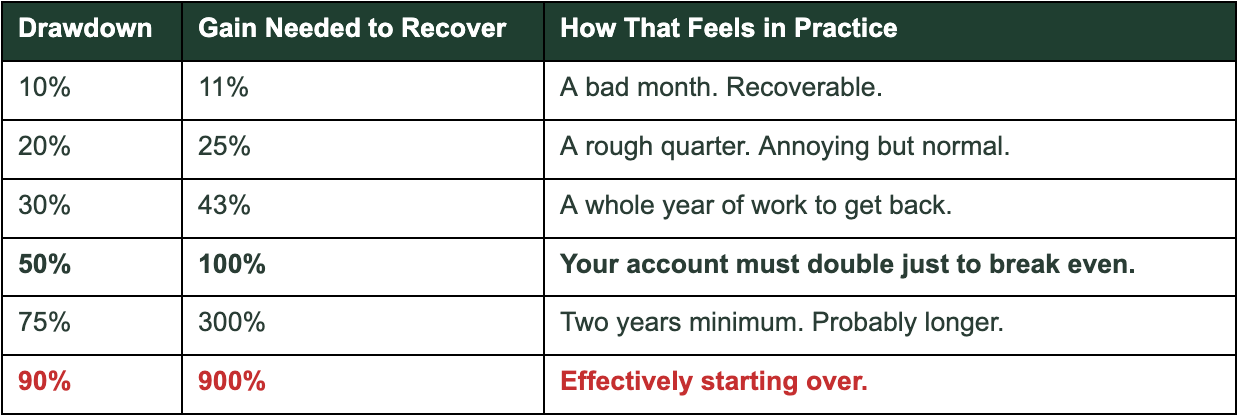
A 50% loss requires a 100% gain to recover. A 75% loss requires a 300% gain. A 90% loss requires a 900% gain. The math gets exponentially harder, not linearly harder.
Every rule above exists to keep you on the top rows of that table, not the bottom ones.
The Real Reason These Rules Work
None of the rules above are complicated. None of them are new. The reason they keep showing up in serious portfolio management is that they’re not really about predicting markets.
They’re about surviving them long enough for the rest of your edge to matter.

Most crypto traders don’t lose money because they pick bad assets. They lose money because they size positions too large, hold too long, and freeze when conditions change. The discipline of risk management is what separates the traders who are still here after five years from the ones who aren’t.
Pick two of the five rules above and apply them this week. Not all five. Two. The trader who actually follows two rules consistently will outperform the trader who knows all five and applies none of them.
The market will always be volatile. Your process doesn’t have to be.
Trade safe!
Mari and Matthew
About the Authors
Mari Savic writes Mari’s Crypto Alpha, helping busy professionals navigate crypto markets. Twelve years in crypto, government crypto advisor and lawyer, raised over $100M from Solana, Animoca, Sequoia, Polygon, and Delphi.
Matthew Snider is the founder of Block3 Strategy Group, author of “Warren Buffett in a Web3 World,” and publisher of the BitFinance newsletter. He holds a Series 65 and MBA, and has been an active participant in digital asset markets since 2015. This article is for educational purposes only and should not be considered financial advice. Always consult with a qualified professional before making investment decisions.
This article is for informational and educational purposes only and does not constitute investment, financial, legal, or tax advice. Securities mentioned involve risk and may not be suitable for all investors. Past performance is no guarantee of future results. Readers should conduct their own due diligence or consult with a licensed financial advisor before making any investment decisions.
 | A guest post by
|