
I run my AI trading research engine from a Telegram chat now. Here’s the setup.
How a partner and I built an autonomous AI trading research agent using Claude Code, Tailscale, and Telegram, plus a practical walkthrough of how to build your own.

There’s a workstation in my home office I call the Forge. We wrote about it recently as the foundational hardware that runs our trading research engine, the autoresearch loop, and the strategy validation pipeline I use to filter real edge from coincidence.
Until this week, the only way to actually use it was to sit in front of it.
That changed yesterday morning.
My collaborator JMD typed a directive into a Telegram chat from his couch a three-thousand miles away, and an AI agent on the Forge wrote and committed code. I was in the kitchen making coffee. Neither of us touched the machine.
Here’s how it works, why it matters, and how you can build something similar.
The stack, in plain English
Three pieces:
Tailscale is a private mesh network. It strings a secure wire between any devices you own without exposing them to the open internet. No port forwarding. No public IP. No “open SSH to the world.” For us, it means our laptops and the Forge talk to each other like they’re on the same local network, even though we live a thousand miles apart.
A Telegram bot is the chat surface. You register one through Telegram’s BotFather utility, you get an API token, and the bot sits as a member of a chat both of us belong to. By itself the bot does nothing intelligent. It’s a pipe that forwards what we type to whatever software we point at the token, and routes the response back. The intelligence sits on the other side of the pipe.
Hermes is the brain on the other side. Hermes is an open-source autonomous AI agent framework from Nous Research, MIT-licensed, that runs as a long-running process on the Forge. When either of us sends a directive through the Telegram bot, Hermes picks it up, opens code files, executes shell commands, writes commits, manages its own permissions, logs everything it did, and reports back through the same chat. It can ask clarifying questions. It can run for hours.
In my setup, Hermes is routed through ChatGPT’s Codex as the underlying model endpoint. Hermes is the runtime, the memory layer, and the orchestrator. Codex is the brain doing the actual reasoning inside that runtime. Those two pieces together are what turn an instruction in a chat into committed code on the Forge without either of us at the keyboard.
The piece worth understanding is the memory loop. After enough tool calls on a complex task, Hermes writes the work out as a reusable skill file in plain markdown that lives on disk. Next time a similar task arrives, it loads the skill automatically and gets faster. The agent compounds. That’s what makes this fundamentally different from a chatbot session that forgets you the moment the window closes.
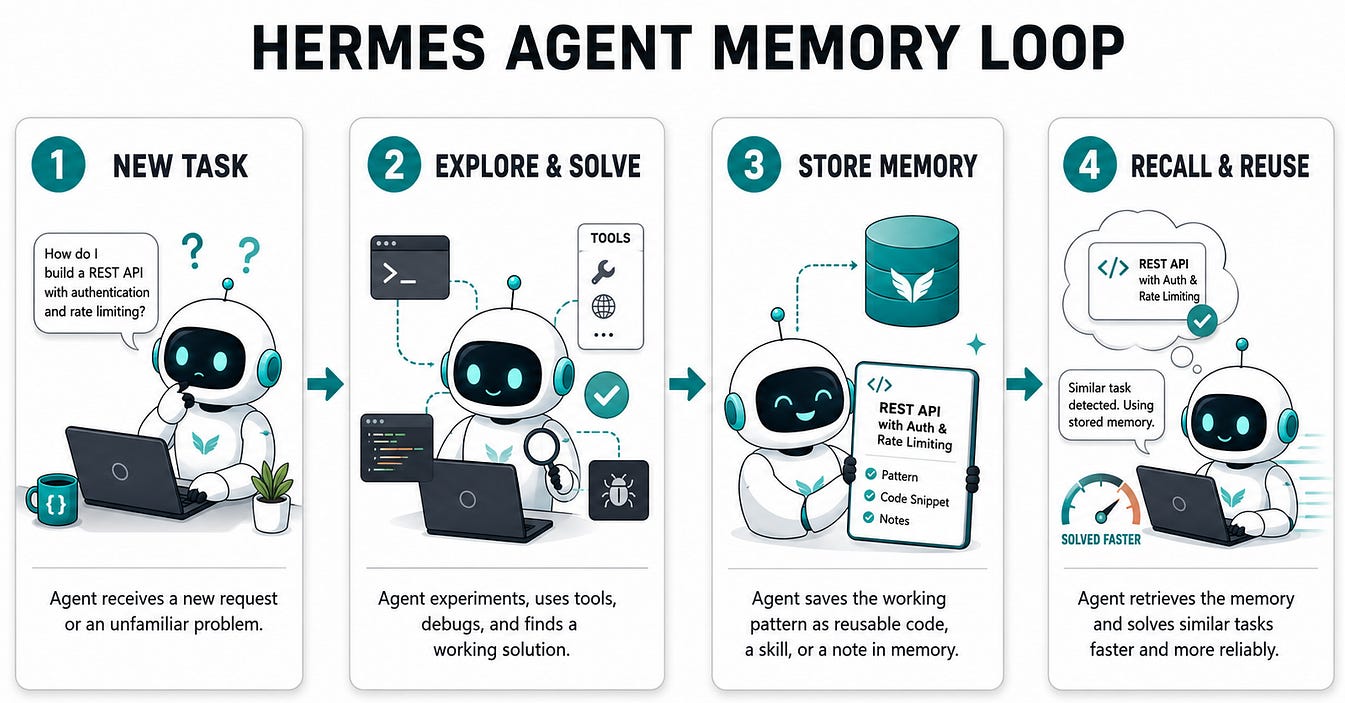
If you read my earlier piece on Openclaw, this is the same family of self-hosted, message-driven AI tooling, just a generation forward. Openclaw is the gateway. Hermes is the agent that lives behind the gateway and learns from what it did. The name fits the function.
In Greek mythology, Hermes carried instructions between worlds. This one does too.
Why this matters
Most “AI trading” coverage you see online is screenshots of someone asking ChatGPT to pick stocks. No infrastructure underneath. No validation. No work happening when the human isn’t typing. The user has to be at the keyboard for anything to happen, and the moment they walk away, progress stops.
What I’m describing here is the opposite of that. It’s the boring, load-bearing plumbing that has to exist before you can actually trust a system to do real work. A real machine. Real version control. An agent that holds context across sessions and writes its own skill library. Whatever happens on the autoresearch engine continues whether I’m asleep, in a meeting, on a flight, or making coffee.
The bigger unlock is collaboration. You can build trading systems alone. It’s slow, it’s lonely, and you miss obvious things because nobody is challenging you. The traditional fix is to be in the same office or to do shared screen calls, but none of that scales for a side operation between two operators with other jobs and other lives.
This setup gives us a shared workspace that is the agent itself. Either of us can direct it from anywhere. Both of us can see what it did. Hermes holds the context, the chat is the audit log, and the Forge does the work. We get the upside of working together without having to be in the same place.
How you’d build this yourself
I’ll keep this practical, because the actual setup is more accessible than it sounds.
You need 4 things.
A persistent machine. Your Forge doesn’t have to be a Mac Studio. A Mac mini, a small Linux box, or an old desktop running headless will work. The requirements are that it stays on, it has enough memory to run an agent runtime comfortably, and you control it. Used Mac minis are cheap. Repurposed gaming PCs are cheaper.
A Tailscale account. The free tier covers up to 100 devices. You install the client on the Forge and on every other device you want to use to reach it. That’s the entire setup. No router configuration. No firewall rules to write. If you can install an app, you can use Tailscale.
Hermes installed on the Forge. The install is a single curl command from the Nous Research repo. It auto-configures most of what you need. You point it at whichever LLM endpoint you want to use as the brain. I’m using ChatGPT’s Codex. You could use OpenRouter, the Anthropic API, or a local model on the same machine if you have the hardware for it.
A Telegram bot. This is the chat layer. Telegram lets you create one through their BotFather utility in about two minutes. You get an API token. You hand that token to Hermes during the install, and Hermes takes care of the rest. No script to write. Telegram is one of the 20+ messaging channels Hermes ships with out of the box.
Total cost to recreate: roughly $0 if you already own a machine and have a model API subscription. Maybe $30 a month if you’re starting from scratch and use the cheapest viable tier. The hardware is the biggest variable, and you probably already have something that works.
The whole thing takes an afternoon if you’re starting cold. The harder part is what you do with it after, not how you set it up.
What it powers
The reason I built this isn’t the chat. The chat is the interface. The reason is the autoresearch engine that sits behind it.
The engine takes a strategy idea and runs it through hundreds or thousands of parameter and regime variations. It applies our multiple-gate validation framework I’ve written about before. It tells me what survives statistical scrutiny and what doesn’t.
That second piece, the trial count, is the one that matters most. Most published Sharpe ratios are meaningless because the publisher doesn’t disclose how many trials they ran to get there. Mine runs the trials explicitly and applies the haircut.
What does that mean for you?
It means the indicators and strategies I write about going forward will have actually been validated, not just back-of-the-envelope plausible. It means I can share work the engine has completed, not just hypotheses. It means the cycle from interesting idea to tested result you can act on gets significantly shorter, because Hermes never sleeps and the machine never logs off.
Here’s a glimpse of the dashboard the agent has been working on.
The first screenshot is the intake form where a new strategy idea gets captured. The second is the Kanban view of the pipeline, showing where every strategy sits today.
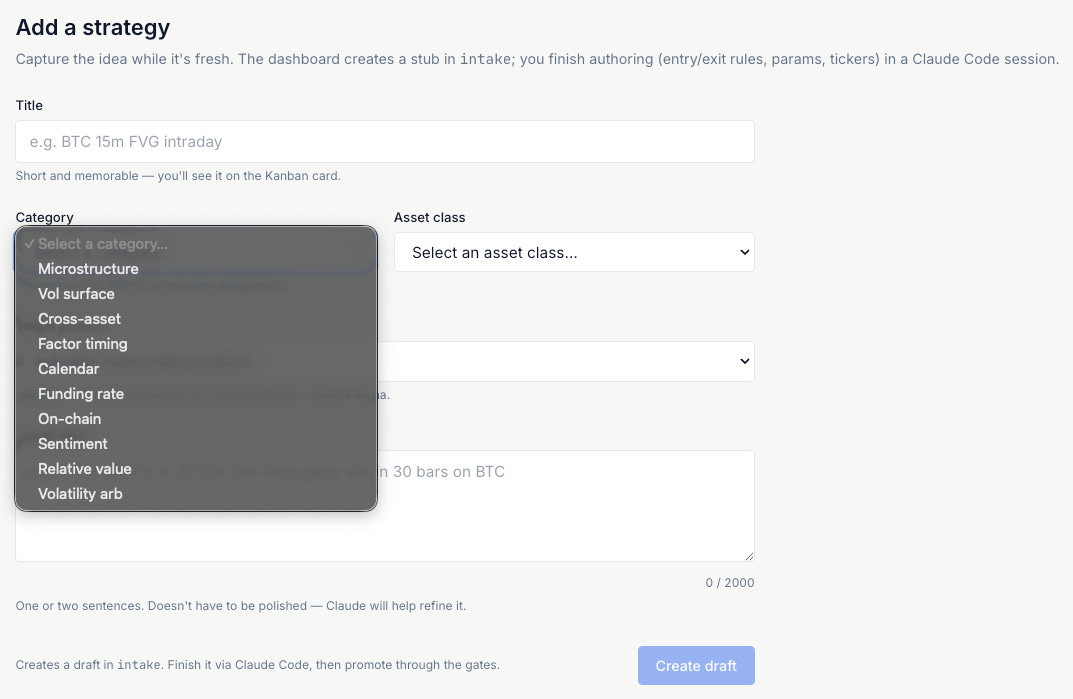
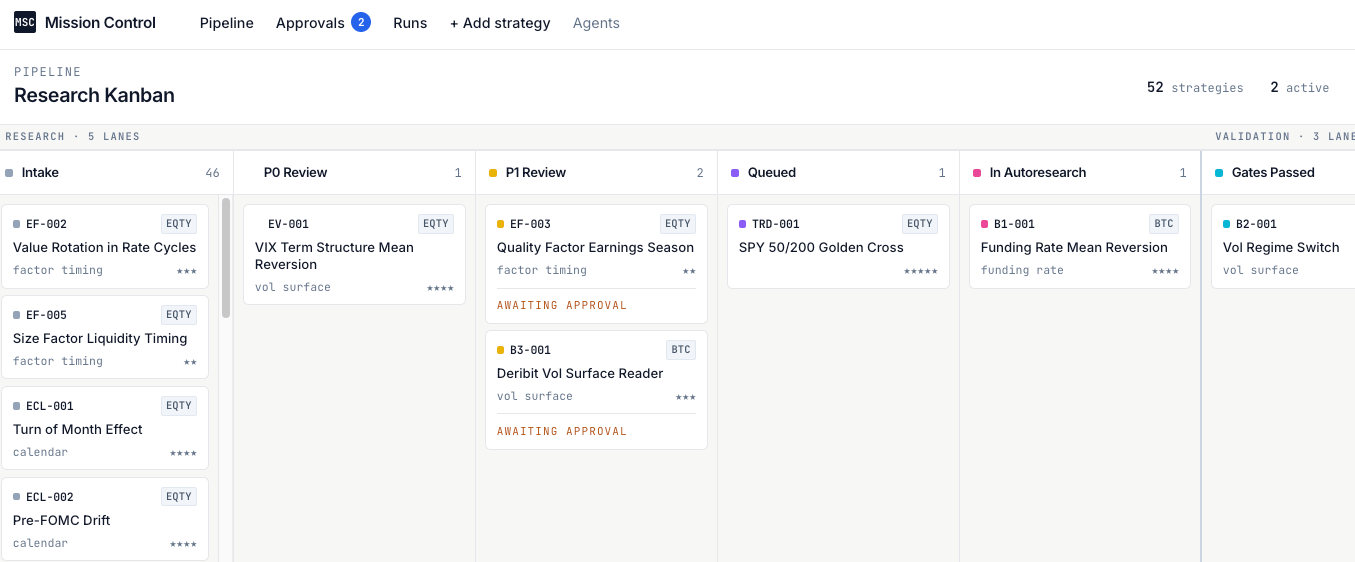
That’s the work that needs autoresearch time, which is exactly why getting the remote-control piece working this week mattered. The bottleneck was never ideas. The bottleneck was machine time, and machine time only counts if the machine is actually running.
Where it can break
Honest part. An agent that can pilot your machine is a real security surface. Tailscale plus tight permission scoping plus a private chat with two known humans is the floor, not the ceiling. Anyone deploying something like this without that posture is asking to lose the machine.
The agent also doesn’t do everything. It’s excellent at coding tasks, file edits, running scripts, and checking the output. It’s not running autonomous trades or making decisions without review. The pipeline is built so a human signs off at each gate. That’s intentional. I’m not interested in giving an LLM the ability to move money without me reading what it did first.
Setup takes some focused time. Maybe an afternoon if you’re starting cold. After that it just runs.
If you decide to try this and get stuck, reply to this post or hit me on Substack chat. I’ll point you somewhere useful. The reason I’m writing it up this way is that I think more retail quants should be running real infrastructure, not just clicking around in apps. The tools are finally cheap enough and accessible enough that there’s no good excuse anymore.
Want to be part of what we’re building?
I’m building the early cohort for when the Discord opens and the first indicators ship. If you want a seat, this is where to claim one.
Interested? Fill out the 30-second interest form here. 👈
moving right along…
This Week in 2 Mins

$1.75 Trillion Is About to Reprice Six Industries (May 19)
SpaceX is reportedly filing for IPO on June 12 at a $1.75 trillion valuation, which would be the largest public listing in history. I used my undergrad-era Virgin Galactic memory as a reminder that getting the timeline wrong on a real narrative is how investors lose money. The actual investable space economy is bigger than the rockets and breaks into six layers:
Launch, in-orbit infrastructure
Satellite services
Communications
Manufacturing and supply
Commodities and power (the bedrock layer)
The bedrock layer is the one nobody is pricing in. Names with real cash flow today, like Iridium, BWXT, and MP Materials, are where the durable bets live. Most of the heat is on the higher-variance names at the top of the stack. The lesson from 2011 was that the businesses underneath the headline outperformed the headline itself. The same is probably true now.
5 Crypto Risk Management Rules That Actually Work (May 21)

A collaboration with Mari Savic! Most crypto traders learn risk management the hard way, and then learn the wrong lesson from it. Five rules that actually work, drawn from how professional portfolio managers run money: don’t risk more than 1-2% on a single trade, set your stop before you enter rather than after, cap the whole portfolio not just individual trades, shrink position size when volatility rises, and preserve capital above everything else.
The core insight binds all five together. Capital you preserve compounds. Capital you lose has to be re-earned at exponentially worse odds. A 50% loss requires a 100% gain to recover. A 90% loss requires a 900% gain. Pick two of the five rules and apply them this week. The trader who follows two rules consistently will outperform the trader who knows all five and applies none of them.
Winners & Losers This Week
Winners 🏆
Kevin Warsh was sworn in Friday as the 17th Fed Chair after a 54-45 Senate vote, the most divisive Fed chair vote in history. The Dow set a record close at 50,580 the same day, and the S&P extended its weekly winning streak to eight, the longest since December 2023.

Nvidia delivered a beat-and-raise midweek that dragged the AI-linked names along for the ride. SoftBank rallied two days straight and added roughly $61B in market cap, one of the largest two-day gains in Tokyo Stock Exchange history.
OpenAI and SpaceX both filed IPO paperwork in the same week. Both are expected to be among the largest U.S. IPOs ever. The 2026 calendar is now genuinely historic.

Losers 📉
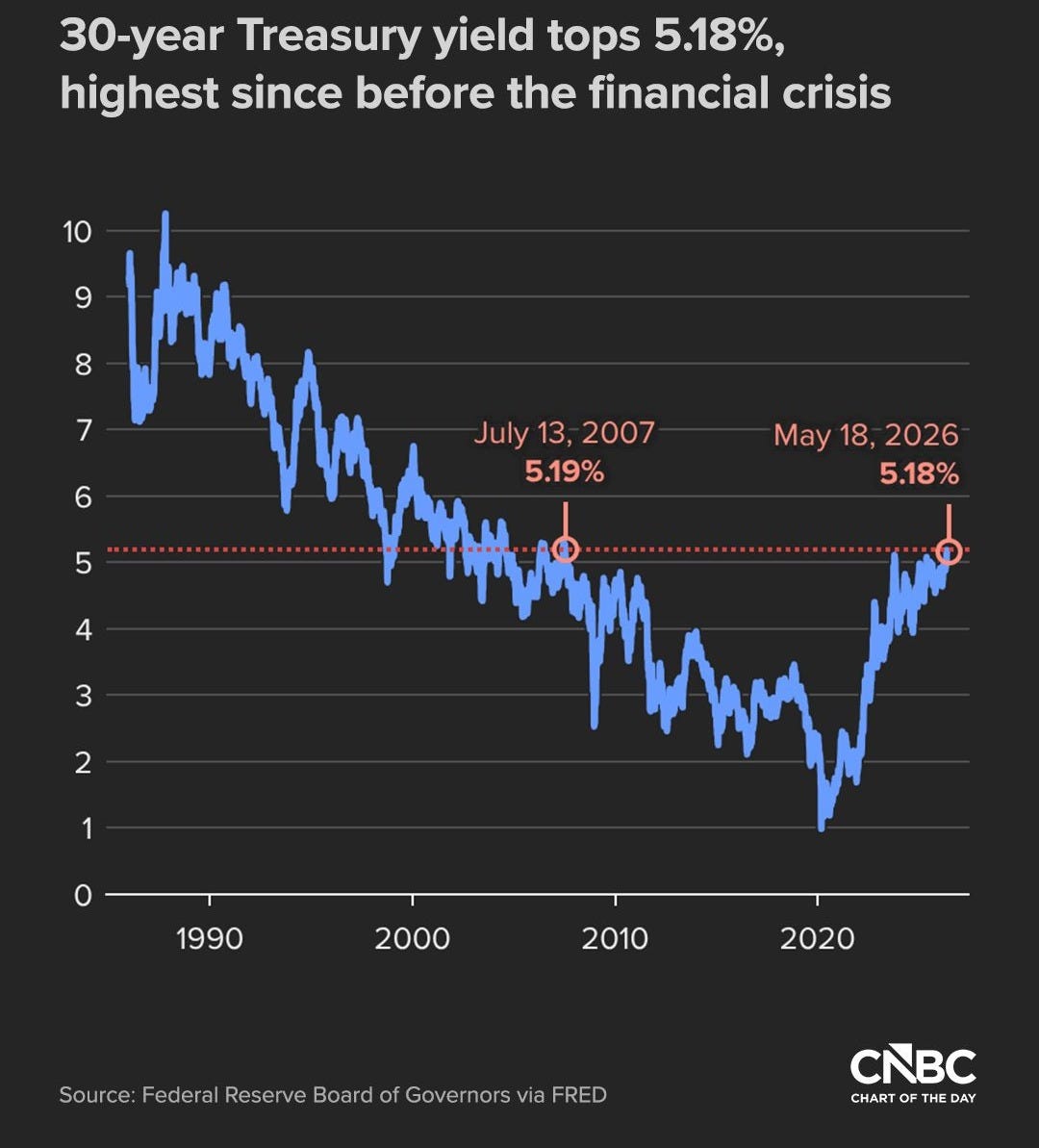
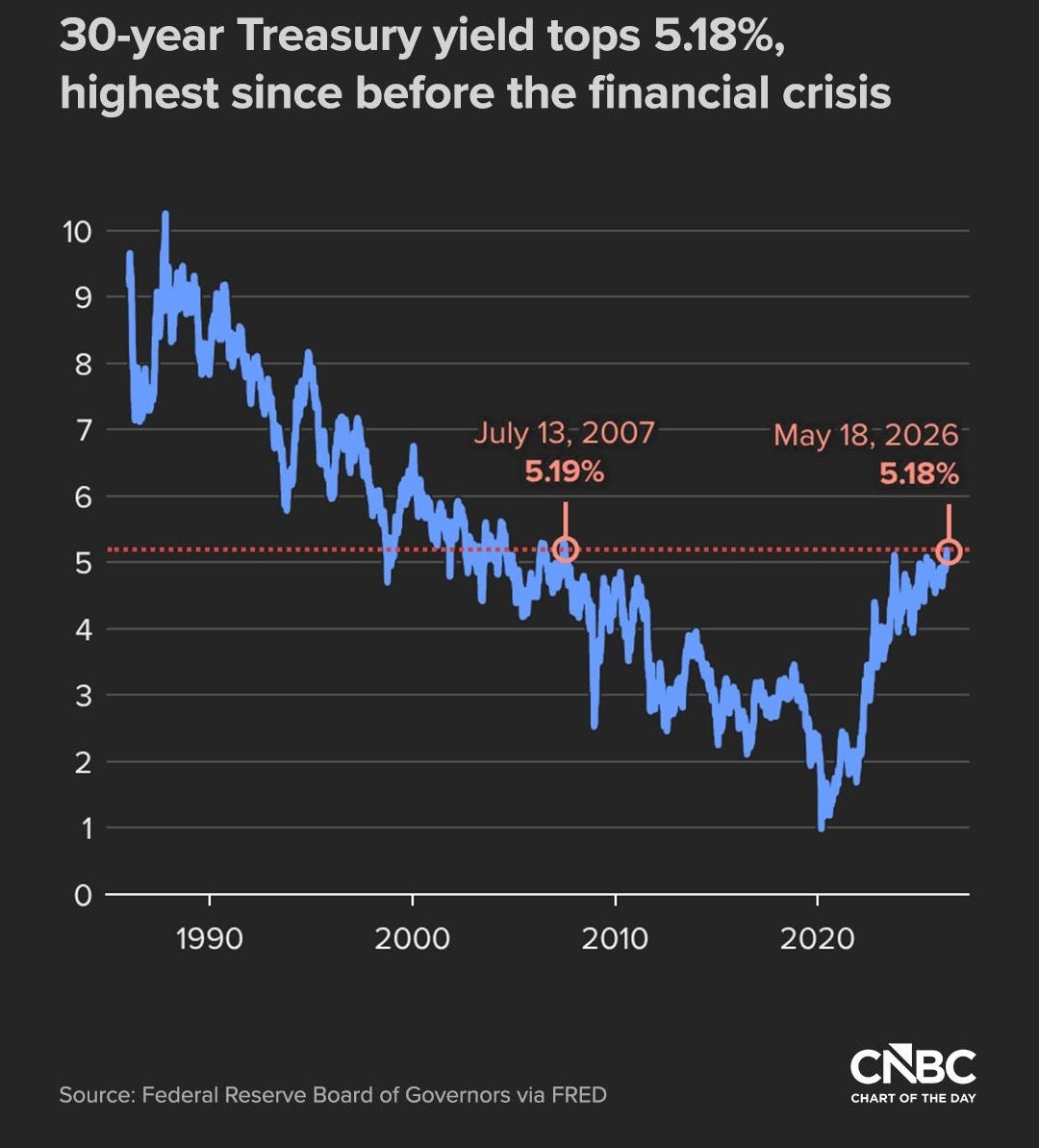
Long-duration Treasury holders. The 30-year yield touched 5.197% midweek, the highest in over a year, pressuring bond prices and rate-sensitive equities before easing late in the week.
Bitcoin spent the week stuck between $76K and $78K, well off the $82K from the prior week. A $563M liquidation cascade on May 18 reset positioning, and the BTC-as-macro-hedge narrative took another hit when a high-profile billionaire investor disclosed he sold most of his bitcoin because it didn’t behave like a hedge during the geopolitical stress.
Walmart, Amazon, and Nvidia (the stock, not the print) closed Friday in the red despite the broader tape rallying, a reminder that index records can mask narrow leadership.
On Deck
Memorial Day shortens the week, but Friday is loaded.
Monday: U.S. markets closed for Memorial Day. 🇺🇸🦅 This means I’ll take my annual trip to the Duke Golf Course.

Friday: PCE inflation, the second revision to Q1 GDP, personal income and spending, advanced trade balance, and Chicago PMI all hit before the open. This is Warsh’s first major inflation print as Fed Chair, and the tape will price the read accordingly.
Retail and enterprise earnings: Salesforce, HP, Costco, Dell, Marvell, Best Buy. Read the consumer prints for actual demand signal, the enterprise prints for AI capex commentary.
Crypto and regulatory: Trump’s executive order kicked off a 120-day Fed review of whether crypto firms should get direct access to Federal Reserve payment services, and the CLARITY Act still has dozens of amendments pending. Slow-burn stories, but next week could surface headlines.

Matthew Snider is the founder of Block3 Strategy Group, author of “Warren Buffett in a Web3 World,” and publisher of the BitFinance newsletter. He holds a Series 65 and MBA, and has been an active participant in digital asset markets since 2015. This article is for educational purposes only and should not be considered financial advice. Always consult with a qualified professional before making investment decisions.